Aristotle Six Elements of Tragedy: Literary Criticism - MyInfocontent.
Aristotle’s Six Elements of Tragedy: Literary Criticism-

Here in this article, you will find the six elements of tragedy by Aristotle in his masterpiece work Poetics. Aristotle’s views on tragedy are helpful to produce a perfect play. He discussed six elements of the tragedy play consisting of Plot, Character, Thought, Diction, Melody, and Spectacle. These six elements are considered basic to play.
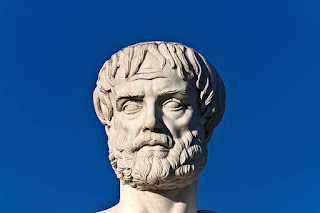
About Aristotle
Aristotle is an outstanding figure in criticism, physics, rhetoric, biology, psychology, metaphysics, mathematics, morals, and politics. He was a student of Plato for twenty years but is famous for denying Plato’s theory of forms. He was more strong and empirically minded than both Plato and Plato’s instructor, Socrates.
A prolific writer, polymath, and lecturer, Aristotle radically changed most of the topics he investigated. In his whole career, he wrote speeches and as many as 200 treatises, but there are only 31 survive. These works are in the shape of draft manuscripts and lecture notes and were never aimed at a general readership. Nonetheless, they are the earliest detailed philosophical treatises we still maintain.
His famous and masterpiece work “Poetics” considered the living philosophical approach of Aristotle toward drama. In this book, he delivered The theory of Tragedy consists of 6 elements.
Definition of Tragedy
"A tragedy is the imitation of an action that is serious and also, as having magnitude, complete in itself; in appropriate and pleasurable language;… in a dramatic rather than narrative form; with incidents arousing pity and fear, wherewith to accomplish a catharsis of these emotions.”
What is Tragedy?
1. “the imitation of an action that is serious and also, as having magnitude, complete in itself;”
This says that a good tragedy consists of one problem that is very “serious.” You can consist of tragedy about something like a dog cutting a child in street. “Magnitude” here indicates great importance. The issue has to be very important as well as serious. That’ is why several tragedies consist of someone’s death. “Complete in itself,” says that the play must hold to one issue; oppositely, the audience will lose their focus on the plot.
2. “inappropriate and pleasurable language:”
Ancient Greek tragedy had a chorus whose role was to comment on the action of the play. The chorus sometimes vocalized their part. The language of the play must understand by the audience. The rhythm and good harmony make the play attractive to listeners.
3. “in a dramatic rather than narrative form;”
Aristotle suggests that the play must be acted or dramatized. On the other side to narrate a story is just to tell the story, as telling a friend about an event or something that happened.
4. “with incidents arousing pity and fear,”
In a tragedy, the episodes or events in the play must arouse pity and fear in the audience they feel sorry for the tragedy that happened to the main hero. The feeling of anger and fear also arouses the audience as the hero leads toward the destructive end.
5. “wherewith to accomplish a catharsis of these emotions.”
As the play moves side by side, the incidents should raise the emotions of fear and pity. Catharsis is cleansing of the emotions–a discharge of tension. In a tragedy, this is always a moment of disclosure when the unfortunate and tragic hero “falls flat on his face,” the audience can ultimately “explode”.
Six Elements of Tragedy:
Plot:
The plot is the central and important part of the play. Aristotle suggests that the plot of the play was the most important element of the six.
He explains, “All human happiness or misery takes the form of action…Character gives us qualities, but it is in our actions–what we do–that we are happy or miserable.” He also discovers two must-step to steps compact and powerful plot.
1. Unity of Plot. This has been discussed in the definition which is that a plot must have one complete action. The event must deal with the main issue and must also be believable and probable.
2. Discovery and peripety –sometimes both.
Discovery is a modification from ignorance to knowledge. This happens to the main tragic hero who starts as clueless and gradually learns how he created a mess around himself.
Peripety is a state of the shift from like high to low, rich to poor, powerful to powerless, or from a beggar to a ruler. It’s a type of transformation from one side to the other the things, in the beginning, look oppolookto the end. The change that brings place in a tragedy should carry the main character and maybe other characters from a level of happiness to a level of misery.
Characters:
Character is the second greatly important element of tragedy. The characters have excellent qualities or nature that are exposed in the plot. The main and moral purpose of every character must be clear to the audience.
Aristotle’s Elements of character in Tragedy
The characters must have four characteristics.
A. No issue who they are (slave or hero), the characters must be good in some way.
B. The characters must act properly for their gender and class in life.
C. The characters must have acceptable personalities.
D. Each character must act invariably throughout the play.
Thought:
Here, by thought, Aristotle suggests the intellectual qualities of character. The speech and lines delivered by the character must be based on a thought-full purpose. The ideas must be clear with the perfect use of arguments and also emotionally appealing. Therefore, the characters should say the right thing at the right time.
Diction:
Diction is the real writing of the lines that are narrated. Thought arrangements with what is said, and diction deals with how it is conveyed. There are several ways to say something. A well-written and composed line that conveyed an extremely excellent message is a quality of a good playwright. In a perfect play, some lines are so effective that the audience makes it a slogan, or they can leave but remember and quote the same lines.
Melody:
Melody means the musical or lyrical element provided by the chorus. The historical tragedies start with song and dance. Music is the element used in a tragedy the singer played the music which can give more interest to the play. They expand different instruments such as fluid and inform the narration of the audience.
Spectacle:
By spectacle, Aristotle suggests that the scenery and costuming played an important role to develop a proper narration of the play. Audience cThe audience understands the tragedy by seeing the stage. Therefore, the costume and stage must be delivered the exact image of the play.
Comments
Post a Comment